
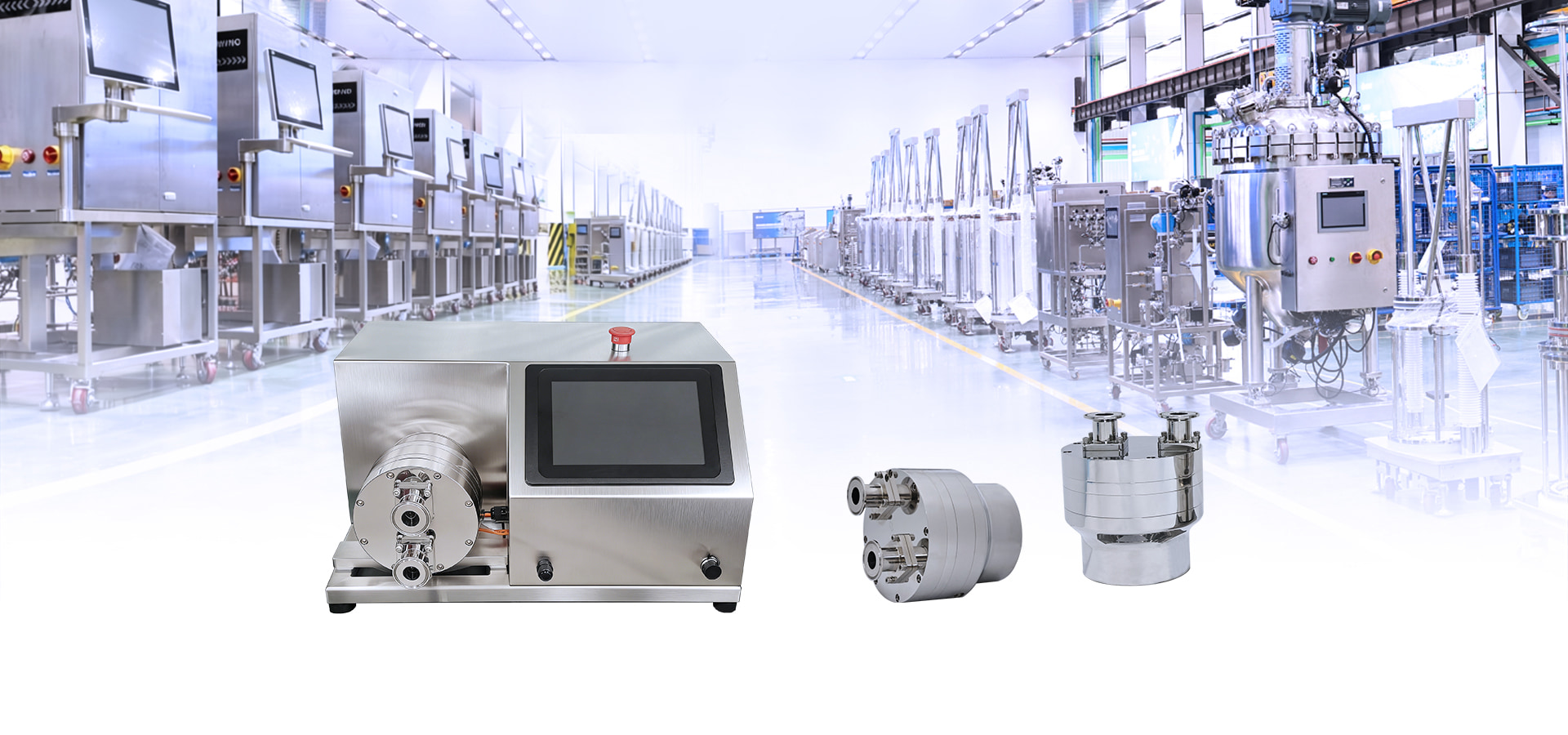
Four-Piston Diaphragm Pump Technology
Understanding the four-piston diaphragm pumping principle for biopharmaceutical fluid handling.
Low shear · Low pulsation · Self-priming · Seal-less hygienic design
What is a Four-Piston Diaphragm Pump?
A Four-Piston Diaphragm Pump, also known as a quaternary diaphragm pump, is a positive displacement pump designed for gentle, low-shear, and contamination-controlled fluid transfer in hygienic bioprocess applications.
Its pumping principle uses four synchronized diaphragms operating in a controlled sequence to produce stable, low-pulsation flow. By separating the product chamber from the mechanical drive with PTFE diaphragms, the design eliminates product-wetted rotating components and mechanical shaft seals, helping reduce contamination risk and particle generation.
The technology provides reliable self-priming capability and stable flow performance across a wide operating range, making it well suited for chromatography, tangential flow filtration (TFF), buffer transfer, sterile filtration, and other applications involving shear-sensitive biological fluids.
How a Four-Piston Diaphragm Pump Works
The TC Series Four-Piston Diaphragm Pump uses four synchronized diaphragms operating in a controlled sequence to generate stable, low-pulsation fluid flow.
An electric motor drives an eccentric shaft and ball-driven transmission mechanism, converting rotary motion into synchronized reciprocating diaphragm movement. Together with precision check valves, this produces continuous fluid suction and discharge.
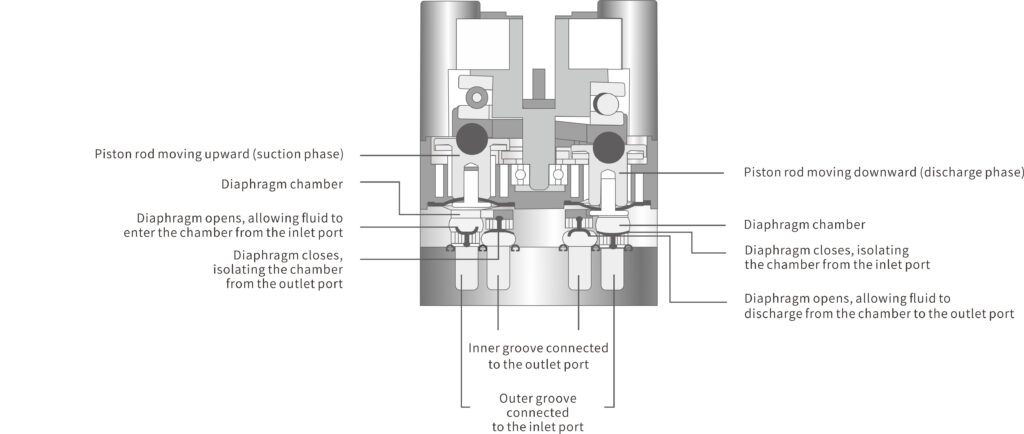
By separating the product chamber from the mechanical drive with PTFE diaphragms, the design eliminates product-wetted rotating components and mechanical shaft seals, significantly reducing contamination risk and particle generation.
The coordinated operation of multiple diaphragm chambers provides stable flow delivery, reliable self-priming performance, and consistent process conditions for sensitive biological fluids.
Pump Head Assembly
The pump head assembly is engineered to provide hygienic fluid handling, reliable product containment, and seamless integration into bioprocess equipment and systems.
By isolating the product-contact area from the mechanical drive with PTFE diaphragms, the pump head minimizes contamination risk while supporting gentle, low-shear fluid transfer. Depending on the application, the pump head can be configured with appropriate sanitary connections and wetted materials to meet different process requirements.

Control and System Integration
The TC Series Four-Piston Diaphragm Pump platform supports both standalone operation and integration into automated bioprocess systems.
For laboratory and process development applications, TC-S Smart Pump models combine the pump head and intelligent controller into a compact platform that provides stable, repeatable flow control and intuitive operation.
For OEM equipment and system integration, TC Series pump heads can be incorporated into externally controlled process systems, allowing flow regulation and process automation to be managed at the system level.
This flexible architecture allows the same pumping technology to be deployed across laboratory instruments, pilot-scale systems, and full-scale biopharmaceutical manufacturing equipment.
Why This Pumping Principle Matters in Biopharmaceutical Processing?
In biopharmaceutical processing, selecting the right pump involves more than flow rate and pressure capability. The pumping principle directly influences shear exposure, pulsation, product integrity, cleanability, and overall process reliability.
For hygienic bioprocess applications involving shear-sensitive fluids, the four-piston diaphragm pumping principle combines gentle fluid handling, stable flow delivery, and reliable product containment. These characteristics make it well suited for chromatography, tangential flow filtration (TFF), buffer preparation, sterile filtration, and other critical bioprocess operations.
Technology Comparison of Sanitary Pumping Principles
Selecting the appropriate pump technology is critical for maintaining product integrity, process stability, and operational efficiency in biopharmaceutical applications.
The comparison below provides a general performance-based overview of commonly used sanitary pumping technologies across key criteria, including product protection, process performance, operational capability, and application fit.
Product Protection
| Parameter | TC Four-Piston Diaphragm Pump | Rotary Lobe | Peristaltic | Centrifugal Process | Pneumatic Diaphragm |
|---|---|---|---|---|---|
| Shear-sensitive fluid handling | Excellent | Moderate | Good | Poor | Moderate |
| Particle generation | Very low | Moderate | Low (tube wear) | Low | Moderate |
| Contamination risk (seal-related) | None (seal-less) | Medium | Low | Medium | Medium |
Process Performance
| Parameter | TC Four-Piston Diaphragm Pump | Rotary Lobe | Peristaltic | Centrifugal Process | Pneumatic Diaphragm |
|---|---|---|---|---|---|
| Flow stability (pulsation) | Very low | Low | Moderate | Very low | High |
| Flow range (turndown capability) | Very wide | Moderate | Wide | Narrow | Moderate |
| Pressure control accuracy | Excellent | Good | Moderate | Limited | Limited |
| High viscosity handling | Excellent | Excellent | Good | Poor | Good |
Operational Capability
| Parameter | TC Four-Piston Diaphragm Pump | Rotary Lobe | Peristaltic | Centrifugal Process | Pneumatic Diaphragm |
|---|---|---|---|---|---|
| Self-priming | Yes | Yes | Yes | No | Yes |
| Dry-running capability | Yes | Limited | Yes | No | Yes |
| Maintenance requirement | Low | High | Medium | Low | Medium |
Application Fit
| Application | TC Four-Piston Diaphragm Pump | Rotary Lobe | Peristaltic | Centrifugal Process | Pneumatic Diaphragm |
|---|---|---|---|---|---|
| Chromatography systems | Excellent | Moderate | Good | Poor | Poor |
| TFF (Tangential Flow Filtration) | Excellent | Good | Moderate | Poor | Poor |
| Buffer & media transfer | Excellent | Good | Good | Good | Moderate |
| High purity dosing / filling | Excellent | Moderate | Good | Poor | Limited |
The ratings above provide a general technical comparison based on the typical operating characteristics of each pumping principle in sanitary and biopharmaceutical applications. Actual suitability depends on fluid properties, process requirements, system configuration, and operating conditions.
Key Technical Advantages
- Gentle, low-shear fluid transfer for shear-sensitive biopharmaceutical fluids
- Stable, low-pulsation flow delivery for consistent process performance
- Seal-less hygienic design with reliable product containment
- Self-priming capability for flexible system integration
- Dry-running capability under appropriate operating conditions
- Well suited for chromatography, tangential flow filtration (TFF), buffer preparation, sterile filtration, and other critical bioprocess applications
Frequently Asked Questions
Why is low pulsation important in biopharmaceutical processes?
Low pulsation helps maintain stable flow conditions in chromatography, TFF, and other sensitive bioprocess applications. Stable flow improves process consistency, protects filters and membranes, and supports predictable separation performance.
What types of fluids are suitable for four-piston diaphragm pumps?
Typical fluids include cell culture media, protein solutions, buffer solutions, cell suspensions, vaccines, biologics, and other shear-sensitive process fluids requiring gentle, hygienic transfer.
How does the diaphragm design support hygienic processing?
PTFE diaphragms isolate the process fluid from the mechanical drive, eliminating product-wetted rotating components and mechanical shaft seals. This design helps reduce contamination risk and particle generation while supporting hygienic fluid handling.
When is a four-piston diaphragm pump preferred over a peristaltic pump?
Four-piston diaphragm pumps are often selected when applications require lower pulsation, higher pressure capability, improved flow stability, or enhanced product containment, particularly in chromatography, TFF, and other critical bioprocess operations.
Are four-piston diaphragm pumps compatible with single-use systems?
Yes. Depending on the application, pump heads can be configured for reusable stainless-steel or single-use systems, supporting integration into a wide range of bioprocess equipment.
Where are four-piston diaphragm pumps commonly used?
Typical applications include biopharmaceutical manufacturing, biotechnology research, laboratory systems, pilot-scale development, OEM equipment, and hygienic process systems.
Need Help Selecting the Right Pump Technology?
If you are evaluating Four-Piston Diaphragm Pump technology for biopharmaceutical, laboratory, or OEM system integration applications, Sainty Flowtech provides application-focused guidance and technical information to help you identify the most appropriate solution.
Contact us to discuss your application requirements.