
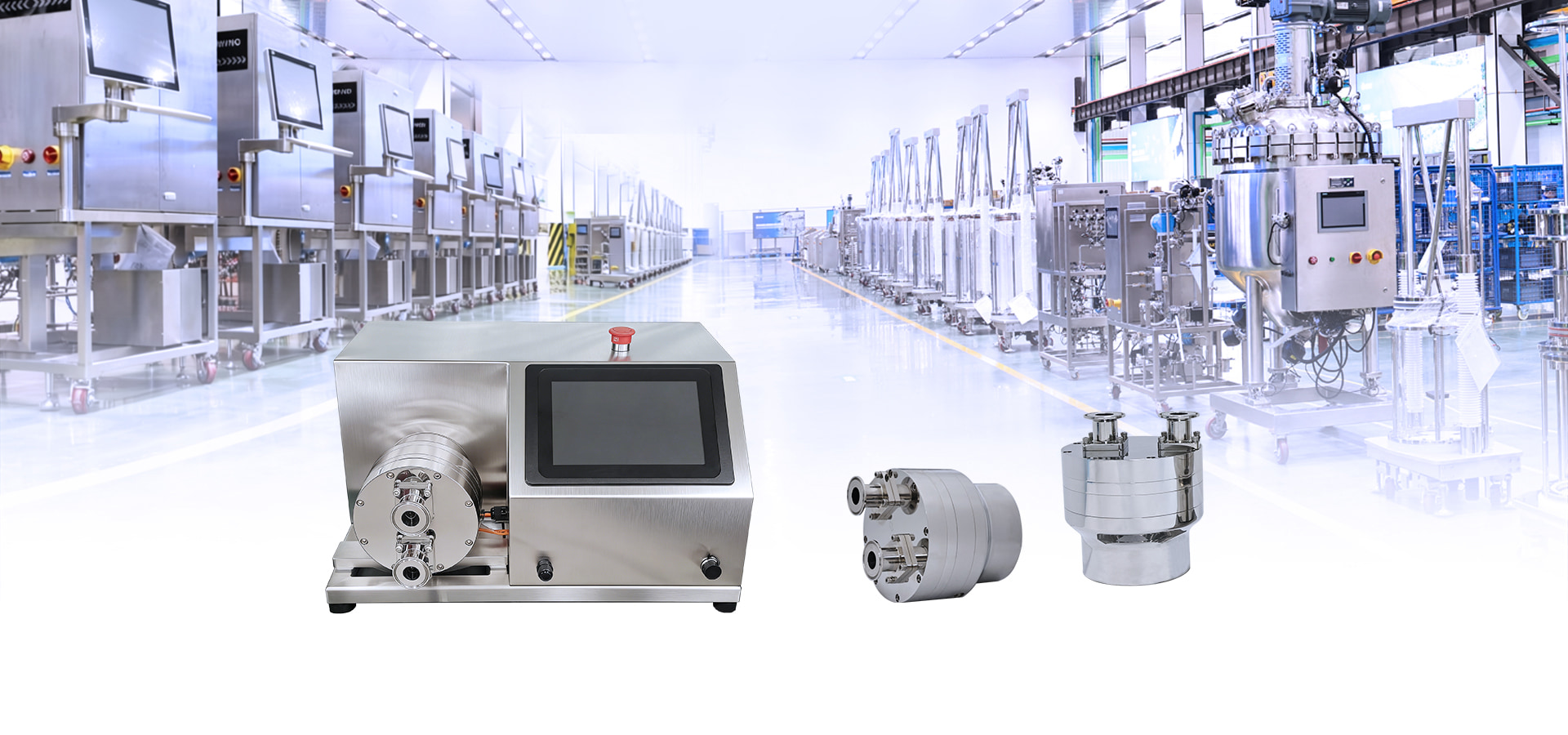
Quaternary Diaphragm Pump Technology
Understanding the four-piston diaphragm pumping principle for sanitary and biopharmaceutical applications.
Low shear · Low pulsation · Self-priming · Seal-less hygienic design
What is a Quaternary Diaphragm Pump?
A quaternary diaphragm pump, also known as a four-piston diaphragm pump, is designed for precise, low-shear, and hygienic fluid transfer in sanitary and biopharmaceutical processing applications.
The pumping principle uses four synchronized diaphragms operating in a controlled sequence to generate a smooth flow profile with very low pulsation. Because the product chamber is separated from mechanical drive components by diaphragms, the design eliminates product-wetted rotating parts and mechanical shaft seals, helping reduce contamination risk and particle generation.
In addition, four-piston diaphragm pumps provide reliable self-priming capability and stable flow performance across a wide operating range, supporting integration into chromatography systems, tangential flow filtration (TFF), buffer transfer, and other processes involving shear-sensitive biological fluids.
How a Four-Piston Diaphragm Pump Works
The Smart TC series quaternary diaphragm pump operates using four synchronized diaphragms driven in a controlled sequence to generate a smooth and stable flow profile with very low pulsation.
The pump is driven by an electric motor. Through an eccentric shaft and ball-piston transmission mechanism, rotary motion is converted into reciprocating diaphragm movement. The reciprocating motion, combined with the opening and closing of check valves, enables fluid suction and discharge.
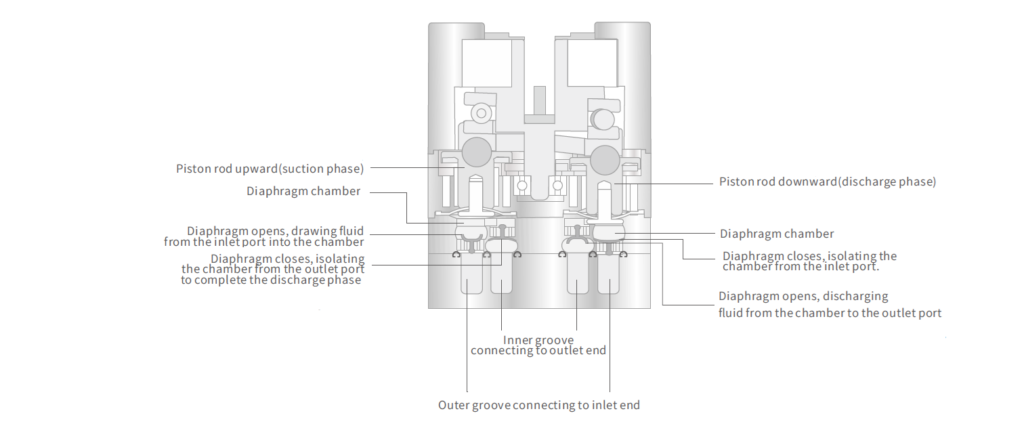
Because the product chamber is separated from mechanical drive components by diaphragms, the design eliminates product-wetted rotating parts and mechanical shaft seals. This configuration helps reduce contamination risk, minimize particle generation, and support hygienic fluid transfer.
The coordinated operation of multiple diaphragm chambers ensures continuous flow output, helping maintain stable process conditions for sensitive biological fluids.
Pump Head Assembly
The pump head assembly is designed to support hygienic fluid transfer, reliable containment, and easy integration into sanitary processing systems.
By separating the product-contact area from the mechanical drive section, the pump head design helps reduce contamination risk while supporting low-shear transfer of sensitive fluids. Depending on the model and application, pump head configurations may include reusable or single-use options, sanitary connections, and application-specific material selections.

Why This Pumping Principle Matters in Biopharmaceutical Processing?
In biopharmaceutical processing, pump selection is not only determined by flow rate and pressure capability. The pumping principle directly influences shear exposure, pulsation level, cleanability, and the overall reliability of the process system.
For shear-sensitive fluids and hygienic processing environments, the four-piston diaphragm principle provides a balanced combination of gentle fluid handling, stable flow characteristics, and reliable product containment. These characteristics make the technology particularly suitable for chromatography systems, tangential flow filtration (TFF), buffer preparation, and other critical bioprocess operations where product integrity, stable flow conditions, and process consistency are important.
Technology Comparison of Sanitary Pumping Principles
Selecting the appropriate pump technology is critical for ensuring product integrity, process stability, and operational efficiency in biopharmaceutical applications. Different sanitary pumping principles exhibit varying performance characteristics depending on process requirements. The comparison below provides a general performance-based overview of commonly used pump technologies across key criteria, including product protection, process performance, operational capability, and application fit.
Product Protection
| Parameter | TC Four-Piston Diaphragm Pump | Rotary Lobe | Peristaltic | Centrifugal Process | Pneumatic Diaphragm |
|---|---|---|---|---|---|
| Shear-sensitive fluid handling | Excellent | Moderate | Good | Poor | Moderate |
| Particle generation | Very low | Moderate | Low (tube wear) | Low | Moderate |
| Contamination risk (seal-related) | None (seal-less) | Medium | Low | Medium | Medium |
Process Performance
| Parameter | TC Four-Piston Diaphragm Pump | Rotary Lobe | Peristaltic | Centrifugal Process | Pneumatic Diaphragm |
|---|---|---|---|---|---|
| Flow stability (pulsation) | Very low | Low | Moderate | Very low | High |
| Flow range (turndown capability) | Very wide | Moderate | Wide | Narrow | Moderate |
| Pressure control accuracy | Excellent | Good | Moderate | Limited | Limited |
| High viscosity handling | Excellent | Excellent | Good | Poor | Good |
Operational Capability
| Parameter | TC Four-Piston Diaphragm Pump | Rotary Lobe | Peristaltic | Centrifugal Process | Pneumatic Diaphragm |
|---|---|---|---|---|---|
| Self-priming | Yes | Yes | Yes | No | Yes |
| Dry-running capability | Yes | Limited | Yes | No | Yes |
| Maintenance requirement | Low | High | Medium | Low | Medium |
Application Fit
| Application | TC Four-Piston Diaphragm Pump | Rotary Lobe | Peristaltic | Centrifugal Process | Pneumatic Diaphragm |
|---|---|---|---|---|---|
| Chromatography systems | Excellent | Moderate | Good | Poor | Poor |
| TFF (Tangential Flow Filtration) | Excellent | Good | Moderate | Poor | Poor |
| Buffer & media transfer | Excellent | Good | Good | Good | Moderate |
| High purity dosing / filling | Excellent | Moderate | Good | Poor | Limited |
Performance ratings shown above are intended as general technical comparisons based on typical operating characteristics of each pump principle in sanitary and biopharmaceutical applications. Actual suitability may vary depending on fluid properties, system configuration, operating conditions, and process requirements.
Key Technical Advantages
- Low-shear fluid transfer suitable for sensitive biologics and aqueous solutions
- Very low pulsation characteristics supporting stable flow conditions
- Seal-less hygienic design enabling strong product containment
- Self-priming capability supporting flexible system integration
- Dry-running capability under appropriate operating conditions
- Suitable for chromatography, TFF, buffer transfer, and other sanitary bioprocess applications
Frequently Asked Questions
Why is low pulsation important in biopharmaceutical processes?
Low pulsation helps maintain stable pressure and flow conditions in chromatography systems, TFF skids, and other sensitive process equipment. Stable flow can improve process consistency, protect filters and membranes, and support more predictable separation performance.
What types of fluids are suitable for four-piston diaphragm pumps?
Four-piston diaphragm pumps are commonly used for aqueous buffers, biological solutions, protein mixtures, cell culture media, and other shear-sensitive fluids where gentle transfer and hygienic design are important.
How does the diaphragm design support hygienic processing?
The diaphragm forms a physical barrier between the process fluid and the mechanical drive components. This separation helps reduce contamination risk and supports hygienic fluid handling in regulated environments such as biopharmaceutical manufacturing and laboratory applications.
When is a four-piston diaphragm pump preferred over a peristaltic pump?
Four-piston diaphragm pumps are often selected when lower pulsation, higher pressure capability, or improved flow stability is required. They are commonly used in chromatography systems and filtration processes where consistent flow conditions are beneficial.
Are four-piston diaphragm pumps compatible with single-use systems?
Depending on the configuration, pump heads may be available in reusable stainless steel or single-use polymer materials. This allows integration into both traditional stainless-steel process skids and disposable bioprocess platforms.
What industries commonly use four-piston diaphragm pump technology?
Typical industries include biopharmaceutical manufacturing, life science research, laboratory equipment manufacturing, and process system integration for sanitary fluid handling applications.
Need Help Selecting the Right Pump Technology?
If you are evaluating sanitary pump technologies for biopharmaceutical, laboratory, or system integration applications, Sainty Flowtech can provide technical information and application guidance.
Contact us to discuss your process requirements.